

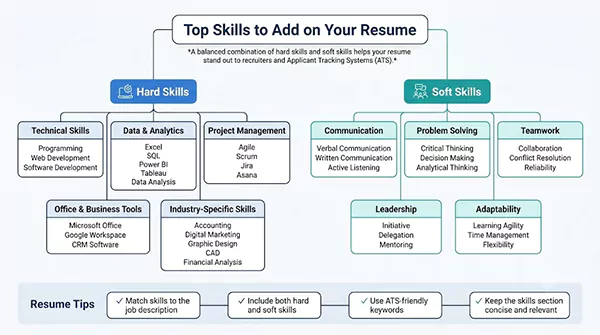
Technical skills, such as cloud computing, programming languages, data science, data analytics, financial skills, project management, and soft skills, like clear communication, adaptability, leadership, and teamwork, are the best resume skills that make it stand out. The Deloitte Survey Report highlights that 78% of the survey respondents consider talent shortages as the top risk for business organizations.
This talent shortage highlights why job seekers must focus on developing and showcasing the relevant resume skills. Simply listing a few generic abilities is no longer enough. Instead, having the right mix of technical and interpersonal skills goes a long way.
This article covers the best resume skills you need to add, practical examples, and tips to make your resume stand out in a competitive job market. Follow along to learn more.
- What are Resume Skills? Why Is It Important?
- Different Types of Resume Skills: Hard Skills and Soft Skills
- Top 5 Hard Skills to Include in Your Resume to Stand Out
- 6 Must-Have Soft Skills That Help Your Resume Get Noticed
- Common Mistakes to Avoid While Creating a Resume
- Wrapping Up!
- Frequently Asked Questions (FAQs)
What are Resume Skills? Why Is It Important?
Resume skills define the abilities and qualifications of a candidate to perform a specific job. These key skills for resume typically include technical skills, job-specific competencies, transferable skills, and interpersonal skills. It helps employers to assess your qualifications and suitability for the job role at a glance.
Why Are Resume Skills Important?
Resume skills are crucial as it presents your job suitability, readiness, applicable skills, and experience at a glance.
Here are some reasons why resume skills matter:
- Highlighting the job-specific skills in a resume helps beat the bots and makes your resume rank higher in applicant tracking systems (ATS).
- It lists the applicable skills and experience that reflect your accomplishments and versatility to the potential employer.
- By presenting the facts, figures, statistics, and quantifiable metrics of your performance, employers can identify your benefit to the company.
- Clearly aligning your talent with the job description enables the employer to identify your job readiness. For example, if the job description mentions “proficiency in Power BI and Tableau”, then mentioning Power BI and Tableau helps the employer filter your suitability.
Different Types of Resume Skills: Hard Skills and Soft Skills
Skills are of two types: hard skills, which include technical know-how and job-specific competencies, and soft skills, which include behavioral and interpersonal skills, such as communication, teamwork, and adaptability.
Here are different types of skills for a resume:
1. Hard Skills
Hard skills are job-related and technical skills that can be learned, measured, and tested. It includes:
- Technology
- Data Science and Analytics
- Financial Skills
- Designing Skills
- Project Management
These skills require a formal education or online learning and certification courses to master. Unlike interpersonal skills, these are practical experiences that may require vocational training and can be proven and tested via certifications.
Important Note:
Hard skills must be backed by evidence. Attach learning certificates, training programs, or a formal education degree.
Give solid examples of how your hard skills created an impact by using statistics and figures. Add relevant keywords to your resume that match your job description.
2. Soft Skills
Soft skills for resume are interpersonal skills that determine your organizational behavior and how you interact with others. It includes:
- Communication Skills
- Critical Thinking and Problem-Solving Abilities
- Time Management
- Leadership Qualities and Emotional Intelligence
- Adaptability
Unlike hard skills, these are behavioral traits that can be learned and transferred.
Top Hard Skills to Include in Your Resume to Stand Out
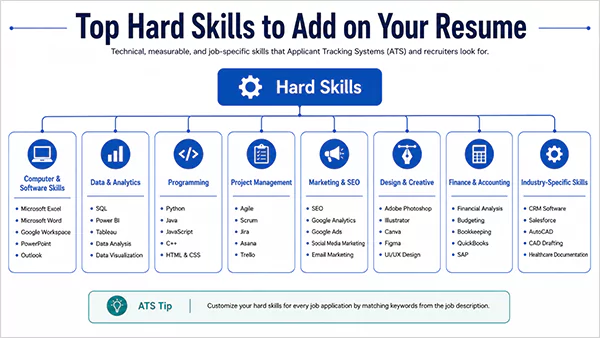
Although your hard skills must align with your job description and profession, adding commonly valued hard skills across industries offers you a vantage point in a highly competitive job market.
Technical skills, such as SQL, cloud computing, HTML, CSS, and data analytics, and analytical skills, such as Power BI, Tableau, data visualization, marketing, finance, design, and project management, are must-have skills on a resume.
1. Technical Skills
Technical skills are the job-specific abilities that enable professionals to perform job-related tasks using software, technologies, equipment, and tools. The US Bureau of Labor Statistics identifies computer and information technology as one of its 17 core workplace skills used to evaluate occupations, which highlights the grave importance of technical skills on a resume.
The technical skills include:
- Cloud Computing
- Google Workspace
- Microsoft Office Suite
- Programming Languages (Python, Java, C++)
- SQL
- Software Proficiency
- Common Operating Systems
How to Learn Technical Skills:
Learning technical skills is best achieved by:
- Identifying your area of interest.
- Taking relevant training or certification courses.
- Working on real-life or demo projects to gain hands-on experience.
- Working in the field through internships or part-time roles for better industry-specific experience.
2. Data Science and Analytics Skills
Data and analytical skills involve collecting, organizing, analyzing, interpreting, and visualizing the data to make informed business decisions.
By identifying trends, generating reports, and identifying bottlenecks with the help of data insights, a business can improve its performance.
Top data and analytical skills on a resume include:
- Microsoft Excel
- Programming Language
- Power BI
- Tableau
- Data Visualization Tools (Matplotlib, Seaborn, etc.)
- Statistical Analysis
- Proficiency in Jupyter Notebooks, NumPy, and Pandas
Future Scope:
- According to the US Bureau of Labor Statistics, the employment of data scientists is projected to grow 34% from 2024 to 2034.
- The median annual wage of a data scientist is $1,12,590 as of May 2024.
3. Financial Skills
Financial skills involve managing a budget, growing money, analyzing financial data, maintaining records, and ensuring compliance with financial regulations. These skills are a must-have for a professional working in the banking and accounting sector.
These financial skills on a resume include:
- Accounting and Book-Keeping
- Audit
- Financial Reporting
- Budgeting
- Tax Preparation
Tips to Develop Financial Skills:
Complete finance-related certifications, such as:
- Chartered Financial Analyst (CFA)
- Certified Financial Planner (CFP)
- Certified Management Accountant (CMA)
Practising financial skills in personal life is one of the best ways to develop financial skills.
4. Design Skills
Creating visually appealing graphics, user interfaces, marketing materials, and multimedia content is one of the crucial resume skills in a world dominated by social media. Creativity and technical expertise help you present ideas effectively through visuals.
Design skills include:
- Adobe Photoshop
- UI/UX
- Canva
- Figma
- Video Editing
Tips to Improve Your Design Skills:
- Learn the fundamentals of color theory, typography, and layout.
- Begin using beginner-friendly tools, such as Canva, and then move to Photoshop or Figma.
- Practice recreating logos, brand posters, and social media graphics.
- Take online courses (if required) and build a portfolio showcasing your best designs.
- Gain hands-on experience by taking internships or part-time design projects before joining a big organization.
5. Project Management Skills
Project management skills are crucial that helps professionals plan, organise, and execute important projects within the time frame and the budget.
These skills include learning:
- Agile
- Scrum
- Jira
- Trello
- Risk Management
6 Must-Have Soft Skills That Help Your Resume Get Noticed
The soft key skills for resume include clear and effective communication, teamwork, time management, adaptability, leadership, and emotional intelligence. Simply listing them won’t make your resume memorable. However, what makes the difference is how you demonstrate them through your achievements and initiatives.
Here are some soft skills for resume and tips on how to present them:
1. Communication Skills
The first and foremost resume skill that a candidate must have is clear, confident, and effective communication. Clear communication does not always involve using vocab-heavy words; rather, clear articulation through verbal, written, or non-verbal communication during interaction makes you stand out among others.
How to Present this on Your Resume:
- Mention the presentations and workshops you’ve conducted.
- Highlight Client Interactions
- You can showcase reports and documentation (if any).
Pro Tip:
Avoid Saying: Good Communication Skills
Instead Write: Increased the click-through rates by 45% by crafting targeted advertisements and email campaigns. (Ensure that it aligns with your job description.)
2. Teamwork
Being a team player offers you an edge over other candidates. The ability to collaborate with colleagues, contribute to group projects, and support others in achieving project objectives is what employers value in a professional.
How to Present this on Your Resume:
- Put forward impactful collaborative projects.
- Highlight your ability to work in diverse teams and fields.
- Give a real picture of how your contribution helped achieve team goals by presenting statistics or numbers.
Pro Tip:
Avoid Writing: I’m a team player.
Instead Write: Collaborated with a team of 15 people to launch a marketing campaign that increased website traffic by 42%.
3. Critical Thinking and Problem-Solving
Critical thinking and problem-solving are must-have resume skills. The ability to analyze and identify the bottlenecks, understand complex situations and diverse perspectives, and finally offer effective strategies makes a candidate best-suited among others.
How to Present this on Your Resume:
- Brief description of how you identified and solved the challenge.
- Give statistics or quantify the improvements that highlight your critical thinking and problem-solving skills.
Pro Tip:
Avoid Writing: I have great problem-solving and critical thinking skills.
Instead Write: Delivered a presentation on workflow inefficiencies and bottlenecks, and introduced an optimal strategy that reduced inefficiencies by 25%.
4. Time Management
Meeting deadlines, handling the designated projects on time, and organising and prioritizing the work are things that top recruiters appreciate and look for in a candidate. Effective time management significantly boosts productivity and reduces workplace stress.
How to Present this on Your Resume:
- Highlight how you handle multiple responsibilities effectively.
- Give a brief real-life scenario of how you organize and prioritize the tasks assigned.
- Showcase consistent deadline achievement.
Pro Tip:
Avoid Writing: I’ve the best time management skills.
Instead Write: Organized and prioritized the tasks depending on the urgency and completed the designated projects ahead of the timeline.
5. Adaptability
In an ever-evolving job market, being adaptable to the changing business environment becomes crucial. With rapidly changing technology, work environments, and responsibilities, recruiters are always on the hunt for candidates who value change, learn new skills, and adapt accordingly.
How to Present this on Your Resume:
- Highlight the time spent on learning new skills.
- Showcase how you easily transition between roles and responsibilities
- Mention the relevant skills and your knowledge of the latest skill sets, such as AI.
Pro Tip:
Avoid Writing: I’m highly adaptable to changing situations.
Instead Write: Successfully learned AI engineering and transitioned smoothly to a new department, while also training the team members on its implementation.
6. Leadership and Emotional Intelligence
The ability to lead, guide, and motivate the team while taking accountability for the consequences makes an individual a great leader. It does not require a managerial title, but rather the ability to take initiative. Managing emotions in complex situations and responding appropriately to the emotions of others reinforces your leadership skills and conflict resolution.
How to Present this on Your Resume:
- Highlight your leadership initiative and the outcomes.
- Mention leading projects or teams.
- Showcase the mentoring or training session that you led.
Pro Tip:
Avoid Writing: I’m a great leader.
Instead Write: Led a team of 20+ people during a product launch and ensured that the project goals were delivered on schedule.
Common Mistakes to Avoid While Creating a Resume
Here are some common mistakes you must avoid in the skills section of a resume:
- Avoid keyword stuffing, although it is important to add relevant keywords to a resume that match the job description; too many skills may overshadow the impact of genuine qualifications.
- Support your hard skill sets with relevant certifications, training programs, a degree, or experience. Quantify your achievements by presenting facts, figures, and statistics.
- Tailor your resume for every job application. Simply using the same resume everywhere lowers your chances of getting interview calls and does not highlight your true potential for that specific role.
- Including only technical or hard skills does not make your resume comprehensive. Add a perfect mix of soft skills and hard skills.
- Do not exaggerate your proficiency level. Be truthful about your skills and experiences in your resume.
Wrapping Up!
To sum up, the soft and hard skills for resume mentioned above are crucial to include in a resume. It offers you a vantage point over other candidates applying for the same position.
Moreover, it is important to focus on the skills that align with the job description and highlight your strengths backed by relevant achievements in that particular field. Lastly, mention the technical skills that you truly master. This will improve your chances of getting noticed and help you stand out in a competitive job market.
Frequently Asked Questions (FAQs)
What are resume skills?
Resume skills define the abilities and qualifications of a candidate to perform a specific job.
What are the best skills for a resume?
Clear and confident communication, problem-solving, adaptability, teamwork, leadership, time management, data analysis, and proficiency in field-specific tools are some of the best skills to add to a resume. However, ensure that these are relevant to the job you’re applying for.
What are the top 7 soft skills for a resume?
Communication, teamwork, adaptability, problem-solving, critical thinking, work ethic, and emotional intelligence are the top 7 skills for a resume that must be added.
How many resume skills should I list?
Ideally, a combination of 8-15 soft and hard skills must be added to the resume. Prioritize quality over quantity and list the skills that you truly master and that match your job description.
Sources: